

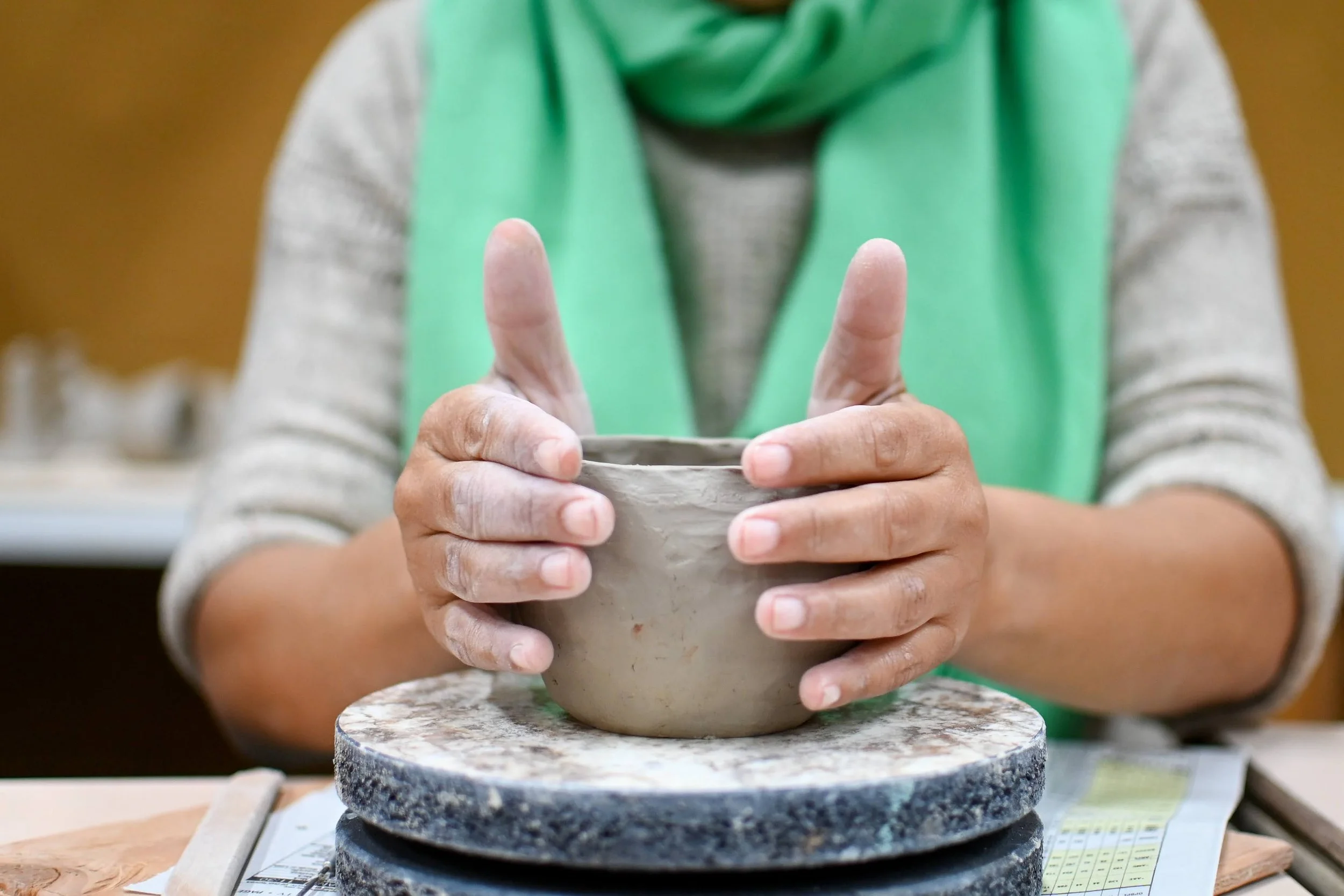
Preserving works in progress- When working on a large project, you often encounter the issue of needing the bottom of a pot or clay object to harden enough to take the weight as you continue to build.
Cover the upper edges with folded damp paper towels and leave the rest of the piece uncovered. When the paper towels are fairly dry, check to see if the bottom area is stiff enough for you to continue.
If you're going to be done for a little bit: Cover the piece loosely with plastic, allowing the bottom area to be exposed to the air. Check on the piece's stiffness every hour or so.
If you'll be back tomorrow: Cover the upper edges with folded, very damp paper towels, then cover the entire piece loosely with plastic.
How to transport- Boxes, blankets, packing or bubble wrap help safely transport work to the studio. Remember, the more bone dry a piece is, the more fragile it is. We recommend bringing your work to the “to be bisqued” shelf before it is bone dry. The studio manager will bisque it when it is ready.
Glazing- All members have access to our in-house underglazes and glazes. All outside underglazes and glazes must be cone 6 and approved by the studio manager.
When you're ready to bisque (cone 010) your work:
Please place your work on a studio wareboard.
Fill out a firing slip and place paper slip on the wareboard with your work.
Place the wareboard on the “to be bisqued” shelf.
We bisque to cone 04 usually on Mondays & glaze fire cone 6 on most Fridays. (This schedule changes in some weeks so double check with the studio manager if needed.)
Safety:
Always control the clay dust in your space and do not wash any clay down your drain.
Only sand your work outdoors with a mask on.
Wear close-toed shoes.
We are happy to dispose of and/or recycle any clay scrap (non-fired only) you may have. Please bring it to the studio and place it in the labeled buckets/bins near the clay sinks.
AT HOME STUDIO
Build at home and fire at our studio. Get into the flow-state at home and bring your work here to fire! We have a round electric Skutt Kiln model 1027 which has 21” interior diameter shelves. We have a variety of clay bodies and basic tool kits for sale in the studio!
What you will need:
Clay- We sell several clay bodies in our studio. All outside clays and glazes must be cone 6 and approved by the studio manager.
Basic Toolkit- We sell basic toolkits in our studio.
Drying space- Whether you choose to dry your greenware before bisque at home or on the studio “to be bisqued” shelf there are key factors for successful, even drying:
Place on a shelf so that air can freely circulate around the piece/s.
Environment plays a large role in how quickly your clay will dry. Keep your pieces out of the sun and away from heaters. AKA no forced drying.
All clay should be bone dry before going in for a bisque fire.
Bone dry is a term used to describe greenware that has dried as much as possible before it has gone through its first firing (the bisque firing). When held, bone dry greenware feels to be at room temperature, not cool to the touch. Coolness indicates that evaporation is still taking place. Bone dry greenware is extremely brittle and will break apart very easily. Therefore, it should be handled as little as possible and great care must be taken when transporting it to the studio and loading it into the kiln.
Slow, even drying is best. If pieces are drying too quickly, cover them loosely with plastic. If there is high humidity, cover the piece with newspaper, then plastic. The newspaper will absorb any condensation.
Dry pots upside down to even out the drying process.